

Our Laboratories
We continue our work under the motto of sensitivity. We established our Physical Testing Laboratory in 2014 and our Analytical Testing Laboratory in 2015.
DeFacto laboratories received confirmation of conformity with the standards of the European co-operation for Accreditation (EA), following the review in the fields of testing, analysis and calibration carried out by TÜRKAK, which signed the Multilateral Recognition Agreement (MLA) with the EA, in all the areas in which it operates. As a reliable indicator of technical competence, this certificate is valid both nationally and internationally, and it also demonstrates DeFacto’s sense of responsibility toward its customers and business partners. Following the audit conducted at our laboratories by TÜRKAK in February 2016, our Analytical Laboratory, and our Physical Laboratory with its extended scope in physical tests, earned the right to be accredited laboratories under the ISO IEC 17025 Standard.
Physical Testing Laboratory
DeFacto laboratories received confirmation of conformity with the standards of the European co-operation for Accreditation (EA), following the review in the fields of testing, analysis and calibration carried out by TÜRKAK, which signed the Multilateral Recognition Agreement (MLA) with the EA, in all the areas in which it operates. As a reliable indicator of technical competence, this certificate is valid both nationally and internationally, and it also demonstrates DeFacto’s sense of responsibility toward its customers and business partners. Following the audit conducted at our laboratories by TÜRKAK in February 2016, our Analytical Laboratory, and our Physical Laboratory with its extended scope in physical tests, earned the right to be accredited laboratories under the ISO IEC 17025 Standard.
Physical Safety Tests
Because of our sensitivity regarding the safety of our baby and children’s products, the safety tests specified in the relevant regulation are followed for these product groups. Flammability Safety: Within the scope of the relevant regulation for baby and children’s clothing, the conformity of all our products (nightgowns, pajamas, bathrobes, dressing gowns, etc.) with flammability directives is checked by following the TS EN ISO 14878 reference test standard.
Baby and Children’s Garment Safety: Garments produced for babies and children are checked for whether they contain small parts that pose risks of entanglement, choking or swallowing, and for their durability. The reference standards used for this purpose are:
- TS EN 14682 Safety of children’s clothing – Cords and drawstrings on children’s clothing – Specifications
- BS 7907 Safe children’s clothing (Checking choking risks resulting from swallowing accessories that are pulled off by hand or by mouth, and checking sharp-edged, pointed metal accessories against scratches and cuts)
Analytical (Ecological Tests) Laboratory
The Analytical (Ecological Tests) Laboratory is a laboratory in which harmful chemicals originating from raw materials and production processes are analyzed in textile products in line with the OEKO-TEX requirements, which are recognized worldwide and applied in more than 40 countries, and in which products that would pose a risk to human and environmental health are eliminated within DeFacto. The analyses carried out in the laboratory demonstrate our sensitivity toward human health and nature and increase our brand’s credibility. The Analytical Laboratory was established with an investment cost of approximately 2 million TL, and with its technical team of 15 people, an average of 100 finished products are analyzed per day. The analyses are carried out with the most advanced devices used in the testing sector and by expert personnel competent in using these devices.
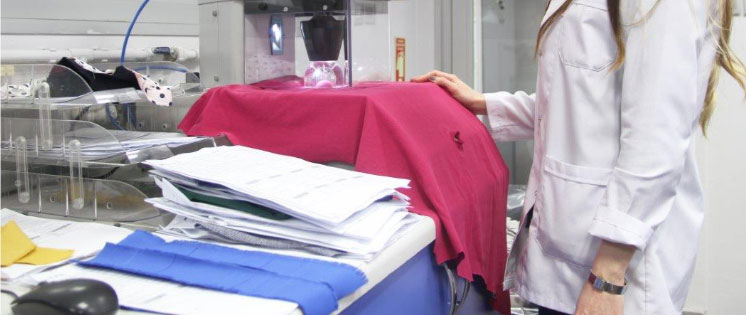
Our Analytical Laboratory was accredited by the Turkish Accreditation Agency in 2016 under the ‘TS EN ISO/IEC 17025:2012’ standard. With its sensitivity to human health, DeFacto established a fully equipped chemistry laboratory in 2014 to prevent the harmful effects of products on health. In this laboratory, chemical substances that are harmful or suspected to be harmful to human health, all of which have been identified through joint work by the World Health Organization (WHO) and the OEKO-100 association, are tested. The tests carried out in the DeFacto laboratory have a broader scope than the tests that are mandatory for products imported into Türkiye. In this laboratory, where tests aimed at meeting global standards as well as local regulations are performed, the results obtained go beyond the limits set by Türkiye. The laboratory, in which an investment of TL 2 million was made for the setup phase alone, has the most advanced technological equipment among its counterparts both in Türkiye and worldwide. The team, made up of chemists and chemistry technicians, consists of experts who have received the best training in their respective fields and have significant experience. Our laboratories, established within the DeFacto headquarters building, enable the sample tests that are mandatory in the sector to be carried out in a safer environment and more reliable results to be obtained. For the components tested, DeFacto laboratories undergo periodic audits by international organizations under the headings of “proficiency testing and inter-laboratory comparison testing.” From time to time, the same products are tested for audit purposes by more than 30 laboratories worldwide that take part in these organizations. The chemicals we use in our testing processes are collected in special barrels so that they do not become waste harmful to the environment, and are delivered to İSTAÇ, an institution authorized by the Ministry of Environment. In this way, all of our chemical waste is disposed of using special methods and reported so that it can be submitted to the Ministry.

Subscribe to out newsletter today to receive updates on the latest news, releases and special offers respect your privacy.
Follow Us
Contact
DeFacto Perakende Tic. Aş
DeFacto Plaza Basın Ekspres Yolu Bahariye Cad. No.31 34303 Halkalı Küçükçekmece İSTANBUL
© 2022 Defacto.com.tr All Rights Reserved.
@DeFacto 2025
Information Society Services